Repetition is installation. Pay attention to what your screen is feeding you.
Not the content — that part you already monitor, more or less. The pattern. Underneath whatever you’re watching or reading, your screen is running a second curriculum, and your nervous system is its only student. It never skips class, and it never forgets a lesson.
The curriculum beneath the content
Here’s what a normal hour on a device teaches, regardless of what’s on it:
Lesson one: nothing deserves sustained attention. Cuts every few seconds, feeds that refresh forever, fifteen-second clips. The rhythm itself trains your attention to release and re-grab, release and re-grab. Then you open a book — a single unbroken stream — and your mind bucks like it’s being punished. It’s not broken. It’s trained. The training was just for something else.
Lesson two: interruption is normal. Every notification is a micro-drill: whatever you’re doing can be overridden at any moment by something unknown. Run that drill eighty times a day and your body learns to hold a low hum of vigilance even in silence — the phantom buzz, the reflexive reach, the feeling of waiting for something that hasn’t happened.
Lesson three: rest is a gap to be filled. Elevator, red light, queue, toilet. Every crack of unstructured time gets caulked with the feed. Your nervous system slowly loses the ability to idle — and idling is where it repairs itself, consolidates memory, and produces most of what you’d call insight. Boredom wasn’t a problem. It was maintenance.
Lesson four: emotional whiplash is standard. Grief, joke, atrocity, ad, wedding, war — inside ninety seconds of scrolling. To survive that carousel your system does the only reasonable thing: it flattens. Feels each thing a little less. That flattening doesn’t stay in the app. It comes to dinner with you.
Why “just be disciplined” fails
None of this is a willpower problem, so willpower won’t fix it. You’re not weak; you’re outnumbered. On one side, a nervous system doing exactly what nervous systems do — learning from repetition. On the other, thousands of engineers optimizing every pixel for one metric: don’t let go.
You don’t win that fight in the moment of temptation. You win it upstream, by changing what gets repeated. Installation works both ways — the same mechanism that trained you can retrain you.
Retraining the student
1. Awareness — see it
For two days, notice the pattern layer instead of the content layer. Catch the reach — the hand moving toward the phone before any conscious decision. Count nothing, fix nothing. Just watch your own installation in real time. It’s uncomfortable and it’s the whole first step.
2. Interrupt — break it
Attack the repetitions, not the device. Kill every notification that isn’t a human trying to reach you directly. Move the phone out of arm’s reach during work and sleep — friction beats discipline. And reclaim two or three daily “gap moments” (the queue, the elevator) as screen-free on purpose. Small, but these are the exact reps the training runs on.
3. Install — live it
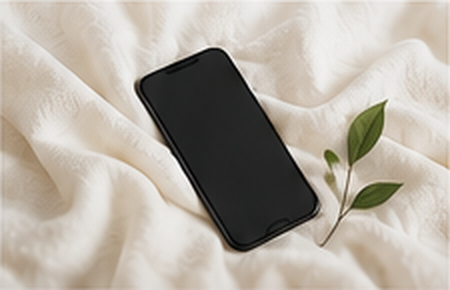
Now feed the opposite lessons. One block of single-stream attention daily — twenty minutes of a book, a full album, a walk without input — to reteach sustained focus. A morning buffer before the first screen, so your baseline gets set by you instead of by the feed. Screens out of the bedroom, so your system relearns that day has an off switch. The phone face-down on the blanket, leaf beside it — that image isn’t an aesthetic. It’s a curriculum change.
4. Become — make it you
Give it three or four weeks of repetition — because repetition is the only language your nervous system speaks — and the new lessons install. The reach fades. Silence stops itching. Attention holds. You’ll pick up the phone and notice you’re choosing to, which may be the single biggest difference a person can feel: using the tool instead of being its training data.
The screen is neutral. The repetition isn’t.
This was never an argument against technology. The screen is a door — to your work, your people, to most of human knowledge. But a door you walk through four hours a day is also a hallway, and hallways shape how you walk.
Your nervous system will be trained by something. That’s not optional — it’s how you’re built. The only choice you get is who writes the curriculum.
Take the pen back.
The book includes a full 30-day nervous system reset. Or start smaller: one practical tool a week, free, in the newsletter.